
TL;DR:
Digital print is now core production infrastructure for most commercial PSPs, while packaging is the industry’s largest segment by value. Production inkjet, automation and sustainability are the growing trends in 2026.
HOW HAVE PRINTING TRENDS CHANGED OVER THE PAST DECADE?
Back in 2016, we highlighted four trends shaping print: digital printing, packaging, multi-channel/cross-media marketing and diversification (in terms of revenue streams). Ten years on, the pace and scale of change of those trends have accelerated, with digital now core to production and printed packaging dominating growth while new forces, such as automation and sustainability, have emerged alongside.
- Digital printing
In 2016, digital print was already proving its value through short runs, personalisation and on-demand production. Today, driven by continued demand for short-run, personalised and flexible production, it’s a core technology for most commercial print service providers (PSPs). Smithers forecasts that the value of the digital print market will be $251.1 billion in 2035, almost 50% higher than its 2025 value, and that, by then, it will account for 22.5% of the global value of all print and printed packaging.*1
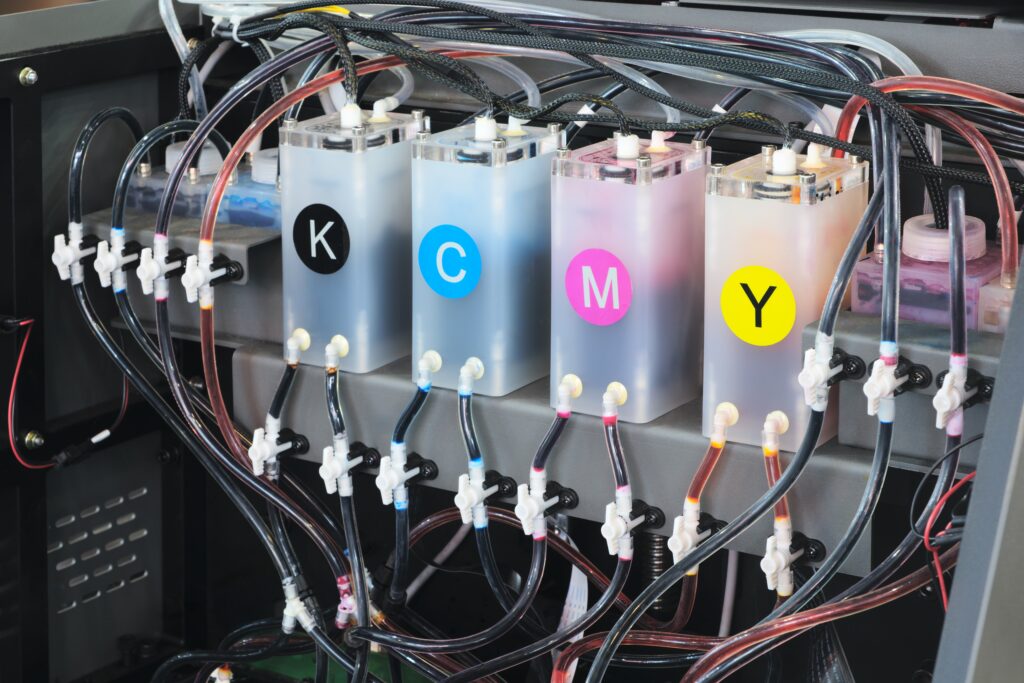
The clearest expression of digital print’s continued rise has been the advances in production inkjet technology. The global inkjet market is experiencing growth in value across both graphic/packaging (5.9% CAGR) and industrial/functional (7.9% CAGR) sectors, with output projected to reach $134.6 billion and $42.7 billion respectively by 2031.*2
Fuelled by the shift from analogue to digital printing, the rise of e-commerce and web-to-print, and its versatility across a vast range of applications, inkjet has become a standard production choice for direct mail, transactional print and commercial colour, delivering lower cost-per-page and faster throughput on short and variable-data runs.
- Packaging
Already a major opportunity in 2016, printed packaging has since grown into the largest segment of the print market by value. While traditional print segments have stayed broadly flat, packaging has expanded consistently, driven by e-commerce growth, food and beverage demand, and rising consumption of packaged goods generally.*3
Smithers estimated the value of printed packaging and labels at $512bn globally in 2024 and forecasts that value to reach $695bn by 2029 at a CAGR of 6.3%.*4
Accounting for over half of the market’s output, flexo remains the most widely used print process in printed packaging, especially for high-volume corrugated board, labels, and flexible formats. However, digital is gaining ground where speed, flexibility and customisation matter. Digitally printed packaging currently accounts for only 1.1% of volume but 3.9% of value – and Smithers estimates that digitally printed output will grow at 12.8% CAGR to 2029.*5
- Multi-channel/cross-media marketing
In 2016, PSPs needed to integrate print into broader marketing strategies but lacked the tools to do it consistently. Over the last decade, multi-channel/cross-media marketing has evolved into programmatic omnichannel automation. Instead of just adding web links to static templates, print can now be used as a physical version of a digital ad as it can be automatically triggered by online behaviour through direct CRM integrations.
Driven by tools like QR codes, print has shifted from mass templates to data-driven, hyper-personalised pieces. Successful PSPs no longer just sell ink on paper but are now marketing partners who use advanced tracking data to prove a clear ROI, and high-impact, tactile direct mail to break through digital fatigue.
- Diversification
Over the last decade, diversification has matured into industry convergence as, with the advances in digital printing technology, the lines between traditional commercial print, packaging and industrial manufacturing have begun to blur.
Wide-format interior décor has evolved from a niche novelty into a mainstream digital print-on-demand standard, producing everything from custom textiles to architectural glass. Separately, 3D printing bypassed local print shops to become a specialised tool for advanced sign-making and industrial fabrication. Forward-thinking PSPs are systematically expanding into high-margin, automated sectors, such as smart labels and packaging, and functional printed electronics for longer term profitability.
Key trends that have emerged since 2016.
Once a vague marketing goal, sustainability has more recently become a primary investment driver across the printing industry as brands and buyers increasingly require verified environmental credentials, enforced by tightening European regulations. This focus on sustainability has further increased the take-up of digital printing because it eliminates chemical printing plates, minimises both set-up and stock waste, and enables highly efficient, short-run production.
Since 2016, the printing industry has also been moving towards what Keypoint Intelligence refers to as “coordinated, intelligence-driven ecosystems”. Automation and AI are becoming standard, moving beyond basic workflows into advanced AI data-tracking, predictive press maintenance and the early adoption of physical robotics to handle materials on the print room floor.
Final thoughts
The businesses leading the industry today have combined digital and analogue production intelligently, are investing in inkjet capability and automation, and now treat sustainability as a business requirement.
How will those businesses look in another ten years?
*1 Smithers ‘The Future of Digital Printing to 2035’
*2 Smithers ‘The Future of Inkjet Printing to 2031’
*3 Grand View Research ‘Packaging Printing Market (2025 – 2030)
*4 Smithers ‘The Future of Package Printing to 2029’
*5 Digital Labels & Packaging ‘Smithers forecasets packaging print market growth’ – October 2024