
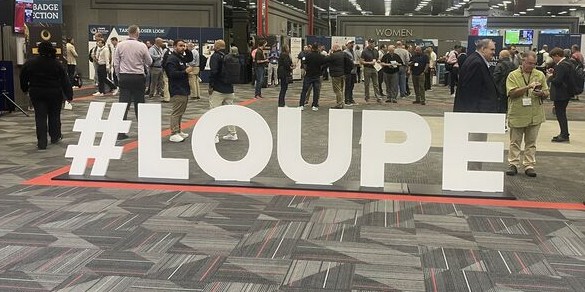
TL;DR: From sustainability and automation to Digital Product Passports, LOUPE Americas highlighted the forces reshaping labels and packaging, with RFID emerging as a key tool for compliance and traceability.
RFID: AN ‘OLD’ TECHNOLOGY FULL OF NEW POSSIBILITIES
What’s in a name? Earlier this month, for the first time, I attended the show previously known as Labelexpo Americas. It is of course a smaller show than its European cousin – but the show floor felt busy throughout most of the two days that I was there. There was a global feel to it (despite some (understandable) US emphasis), and most exhibitors I spoke with had had a positive experience in securing leads and building networks throughout the event.
The exhibition’s name change (to Labels and OUter Packaging Embellishment) is a clear indication of the organisers’ intent to broaden the exhibitor and visitor base beyond the labels industry to all forms of packaging technology and development, and there was certainly some prominent evidence of this.
Labels, however, remained by far the biggest focus. And there was plenty to say about them!
Topics and themes
Sustainability is an evergreen topic in the industry and there was plenty of discussion around that in the talks on the Spotlight stage and on the stands.
The mainstreaming of digital and hybrid label and packaging press production was another prominent theme, as was the rise in automation – especially AI-assisted automation, workflow optimisation and robotics. One major draw to drive this point home was an unnervingly nimble humanoid robot, about the size of a 10-year-old child, which pottered around one of the stands to promote AI-powered workflow tools.
RFID as a tool for compliance in a complex legislative world
One of the biggest topics that struck me, was an emphasis on RFID tags and integration. Though far from being a new technology (tracing its origins back to WWII) my LOUPE experience certainly suggested that RFID technology is right back at the top of the labels and packaging agenda – driven in large part by the complex and rapidly developing legislative landscape.
Multiple exhibitors highlighted RFID and NFC-enabled packaging as a way to support emerging Digital Product Passport requirements and broader traceability expectations. Instead of having to cram extensive compliance information on-pack, the RFID tag becomes a gateway to a cloud-based record which can contain almost limitless information, including (but not limited to):
- Material composition
- Recycled content
- Country of origin
- Carbon footprint data
- Recycling instructions
- Repair/reuse information
- Packaging certifications
- Regulatory declarations
This is particularly relevant as Digital Product Passports move from concept toward implementation in Europe and EPR and PPWR regulations are enforced. In this new world, RFID-enabled labels can act as a durable, tamper-resistant alternative or complement to QR codes for accessing a huge volume of information.
In a world in which regulators increasingly want traceable data and evidence, not just claims, packaging companies and brands are being asked to demonstrate everything from material provenance, to volumes of recycled content, supply-chain custody, product authenticity and end-of-life outcomes. A volume of information, at a level of complexity, that simply can’t be recorded on a physical package or label.
QR codes of course provide a solution here as well, but QR codes can be easily damaged or destroyed. RFID provides a much more robust digital audit trail.